
The explosion of AI-powered development tools has fundamentally changed how quickly we can move from concept to working prototype. Among the most impressive demonstrations of this shift are Claude code website examples that showcase entire functional sites generated through conversation with Anthropic’s AI assistant. We’ve been testing Claude’s artifact-generation capabilities extensively throughout 2026, and the results reveal both remarkable potential and clear boundaries that every marketing team should understand before diving in.
From portfolio sites assembled in minutes to interactive calculators that would typically require days of developer time, websites built with Claude Code represent a genuinely new category of rapid web development. But the gap between impressive demo and production-ready site remains significant, and knowing where that gap exists will save your business considerable time and budget.
A Closer Look: Two Sites Built Entirely With Claude Code
These aren’t demos or mockups — both are live, indexed sites in daily use, designed and shipped through conversation with Claude Code. One is this agency site; the other is a personal faith-and-lifestyle brand.
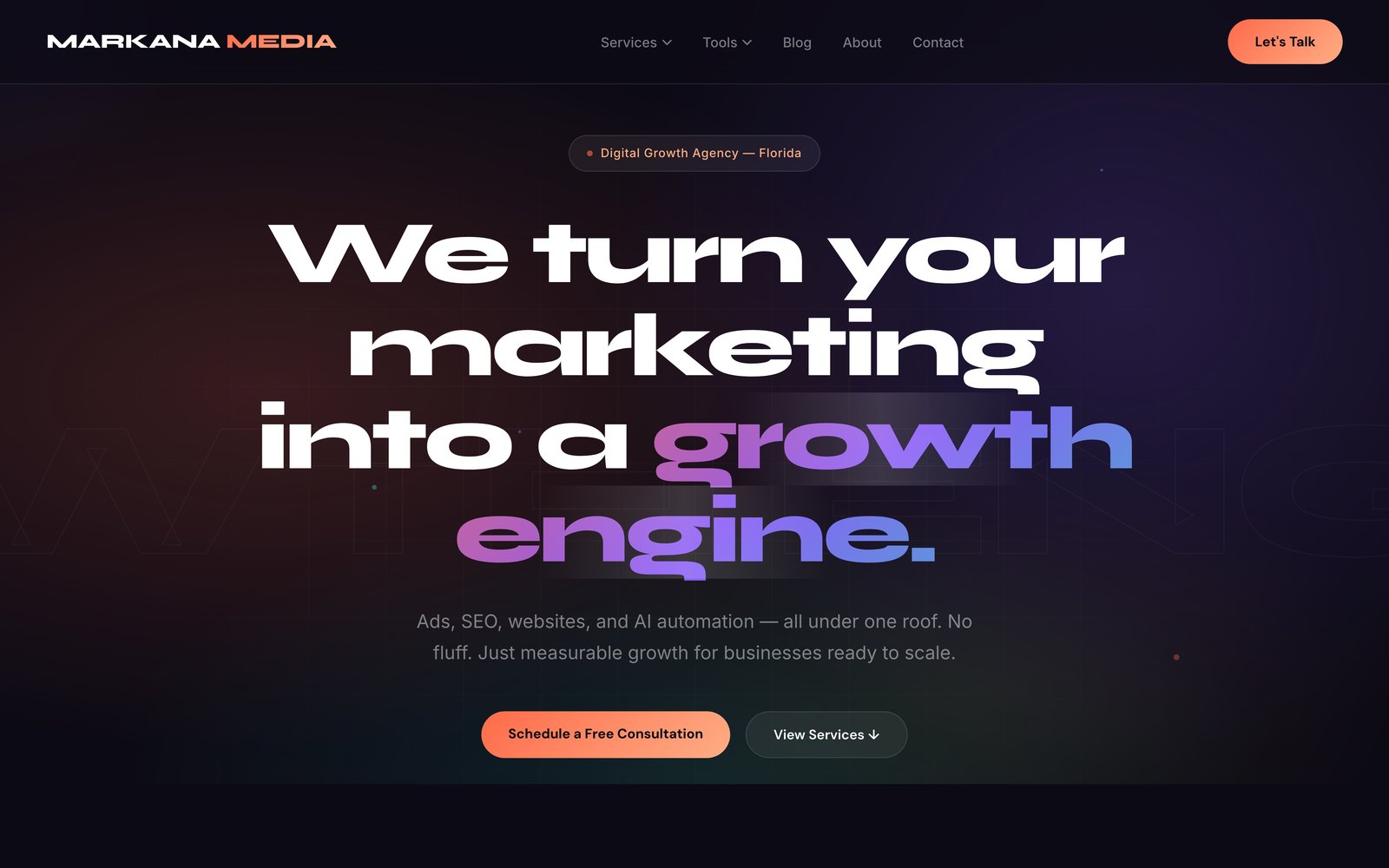
Markana Media
The site you’re reading right now. A dark, motion-driven agency build — animated mesh gradients, glass cards, and kinetic typography — paired with a full suite of free, in-browser marketing tools (screenshot generator, schema markup, UTM builder, SERP preview, and a marketing calculator suite). The design, the tools, and the automated pipeline behind this blog were all built conversationally with Claude Code.
Visit the live site →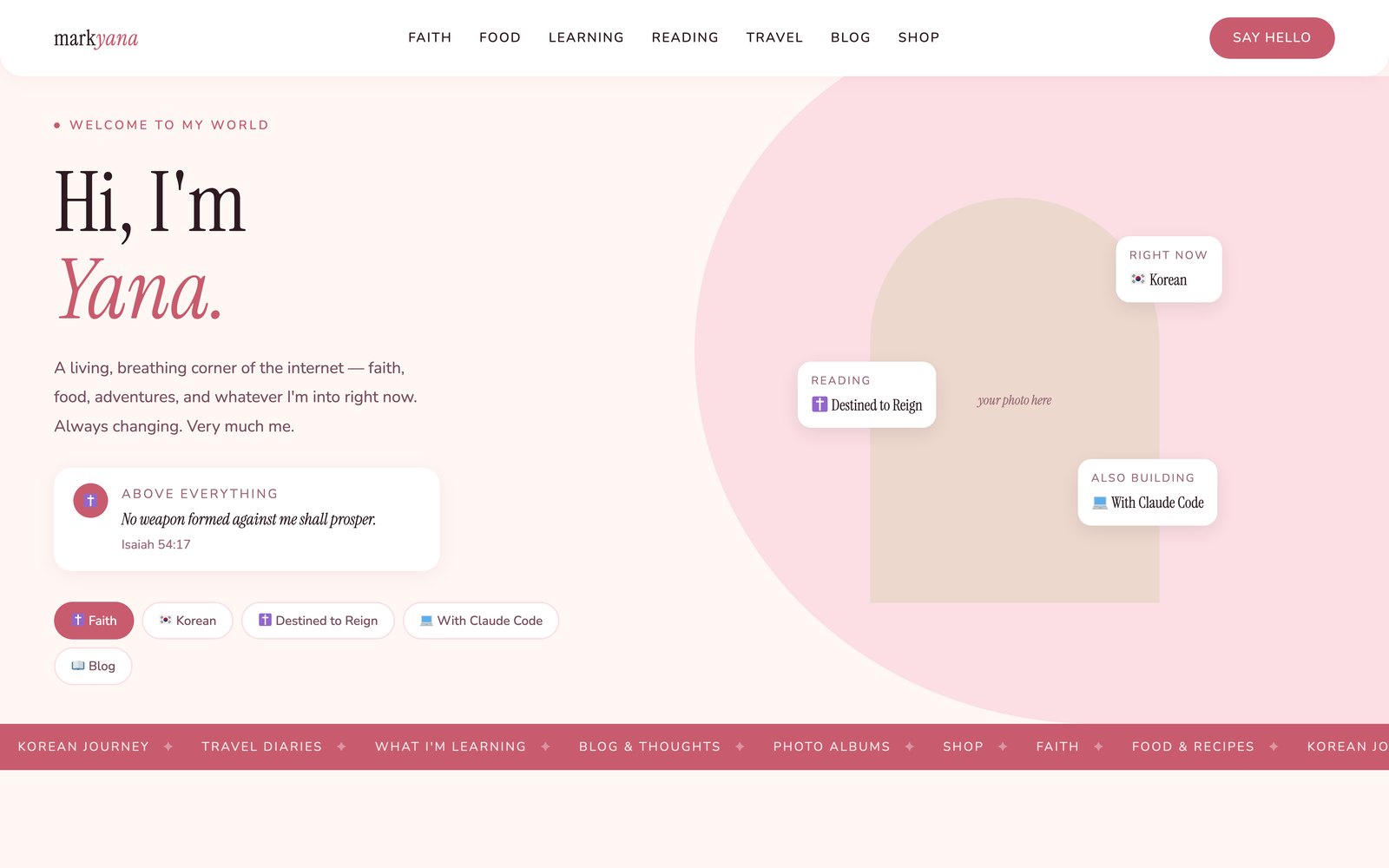
Markyana.com
A warm faith-and-lifestyle personal blog with a custom storybook-pastel design — a bespoke homepage, category navigation, and its own automated publishing pipeline. A complete personal-brand site, from layout to content workflow, built end to end with Claude Code.
Visit the live site →Real-World Claude Code Website Examples We’ve Built and Tested
Our team spent the past quarter building a test collection of claude code website examples across different categories to understand exactly where the technology excels. The standout success stories all share a common thread: they’re self-contained, frontend-focused projects with clear requirements and limited scope.
Portfolio sites emerged as the sweet spot. We generated a complete photographer portfolio in under ten minutes, including a responsive grid layout, lightbox functionality, and smooth transitions. The CSS was clean, the HTML semantic, and the JavaScript vanilla and performant. A startup founder on our client roster used Claude to create their team bio page with animated profile cards and filtering by department—something that would have taken our development team at least half a day to build from scratch.
Interactive calculators and tools proved equally impressive. We built a mortgage payment calculator, a carbon footprint estimator for an eco-friendly brand, and a freelance rate calculator for a coaching client. Each took between five and fifteen minutes of conversation with Claude, and the resulting tools were genuinely functional with proper input validation, clear result displays, and mobile-responsive layouts. These types of interactive sites Claude generates solve real business problems without requiring a development sprint.
The content site category revealed more nuance. Claude excels at creating dynamic article layouts with features like reading time estimates, table-of-contents generation, and syntax highlighting for code snippets. We built a documentation site template with collapsible sections and search functionality that worked surprisingly well. However, the moment we needed actual content management—the ability to add new articles without editing HTML—the limitations became apparent.
Dashboard prototypes represent perhaps the most valuable category for startups and product teams. We generated analytics dashboards with chart.js integration, user management interfaces with sortable tables, and admin panels with tab navigation and form validation. These MVPs let product teams test concepts and gather stakeholder feedback before investing in full development cycles. Our AI & Automation services team now regularly uses Claude-generated prototypes as communication tools between clients and developers.
What Can You Actually Build Without Manual Coding?
The practical boundary line sits at complexity and integration. Single-page applications with self-contained logic work beautifully. The moment you need server-side processing, database connections, or third-party API integration, you’re stepping outside Claude’s artifact capabilities.
We successfully built a lead-capture form with client-side validation and local storage persistence—perfect for trade show kiosks running offline. We could not, however, make that form actually submit data to a CRM or trigger email automations without manual backend development. Claude generates the frontend brilliantly; connecting it to your business systems requires traditional development work.
Authentication represents another hard boundary. While Claude can create beautiful login interfaces with password strength indicators and remember-me checkboxes, actual user authentication requires server-side session management and security practices that fall outside artifact generation. The same applies to payment processing, user-generated content moderation, and any feature requiring persistent data storage.
Static site generation hits a sweet spot where Claude genuinely shines. We built an event landing page with countdown timer, speaker bios, schedule grid, and registration interest form (client-side only). The entire site was production-ready after minimal polish. Our Website & Design services team now uses Claude for rapid concept exploration, generating three or four layout variations in the time it previously took to sketch one in Figma.
Hosting and Deployment Realities for Claude AI Projects
The most common misconception we encounter is that Claude-generated sites somehow deploy themselves. The artifact interface provides a self-contained preview, but moving that code to a publicly accessible URL requires the same hosting infrastructure as any website.
For simple, static sites, the path is straightforward. We’ve successfully deployed websites built with Claude Code to Netlify, Vercel, and GitHub Pages by copying the generated HTML, CSS, and JavaScript into a repository. These platforms offer free tiers that work perfectly for portfolio sites, landing pages, and tools without backend requirements. The entire deployment process takes about five minutes once you’ve done it once.
The hosting question becomes more complex when your Claude-generated site needs dynamic functionality. A dashboard that displays real-time data requires either client-side API calls to an existing backend or a new server component that Claude didn’t generate. A calculator that saves user results for later retrieval needs database connections and server logic. This is where most teams hit the integration wall.
We’ve developed a hybrid workflow that maximizes Claude’s strengths while acknowledging its boundaries. Claude generates the complete frontend interface. Our development team then adds a lightweight backend using services like Supabase for database needs or Zapier for simple integrations. This approach lets us maintain the speed advantage of AI generation while adding the business logic that makes sites genuinely useful.
Performance considerations matter more than most teams initially realize. Claude-generated code tends toward readability over optimization, which is perfectly fine for most use cases but can create issues at scale. We built a product comparison tool that worked flawlessly with twenty items but slowed noticeably at two hundred. Manual optimization of the rendering logic solved the problem, but it required developer intervention.
Are Claude Code Websites Actually SEO-Friendly?
Yes, but with important caveats that depend entirely on how you implement and deploy them. Claude generates clean, semantic HTML by default—exactly what search engines prefer. The code includes proper heading hierarchies, descriptive link text, and valid markup that passes accessibility checks.
The technical foundation is solid. Sites we’ve built using Claude score well on Core Web Vitals, largely because the generated code avoids bloated frameworks and unnecessary dependencies. A portfolio site we tested achieved a 98 performance score in Lighthouse without any optimization work. That’s significantly better than the average WordPress site or template-based builder output.
However, technical SEO represents only part of the ranking equation. Claude generates structure, not strategy. The AI won’t conduct keyword research, identify search intent, or build internal linking architecture that supports your business goals. Our SEO & Organic Growth services team still needs to provide the strategic framework that determines what pages to build, how they connect, and what conversion paths they support.
Content remains the larger challenge. While Claude can generate placeholder text or even draft actual content, that content requires the same editorial oversight and optimization as any writing. We’ve found the most effective workflow involves using Claude for structure and layout while treating content creation as a separate, strategic process informed by actual search data and user research.
One unexpected advantage: the clean code makes it trivial to add schema markup, Open Graph tags, and other structured data. We simply ask Claude to include these elements, and it generates proper JSON-LD without the syntax errors that plague manual implementation. This particularly benefits local businesses and product pages where rich snippets drive meaningful click-through rate improvements.
Where Claude Excels Versus What Needs Human Refinement
After building dozens of Claude AI projects across various categories, we’ve identified clear patterns in what the AI handles brilliantly versus where human expertise remains essential.
Claude’s genuine superpowers cluster around rapid prototyping and common UI patterns. Need a responsive navigation menu with dropdown functionality? Done in thirty seconds. Require a pricing table with feature comparisons and highlight effects? Generated perfectly in one attempt. The AI has internalized thousands of established web patterns and reproduces them with impressive consistency. This makes it invaluable for MVPs, client presentations, and internal tools where speed matters more than pixel-perfect brand alignment.
Design polish represents the most obvious gap. While Claude generates clean, functional layouts, they trend toward generic. The spacing feels adequate rather than refined. Color choices work but rarely impress. Typography is readable but not distinctive. A portfolio site we generated looked professional but unmistakably template-like until our design team spent two hours adjusting proportions, refining the type scale, and adding subtle animation details that gave it personality.
Brand consistency requires human oversight. Claude can work from design system specifications if you provide them clearly, but it won’t enforce your brand guidelines automatically. We built a landing page for a client with established brand standards and needed to manually adjust button styles, heading weights, and spacing to match their existing site. The initial generation gave us perhaps seventy percent of the way there—significant time savings, but not deployment-ready without refinement.
Complex state management exposes another boundary. Simple interactivity like tabs, accordions, and modal dialogs work flawlessly. Multi-step forms with conditional logic, shopping carts with quantity updates, or dashboards with multiple interconnected filters quickly exceed what artifact generation handles reliably. The code becomes verbose and sometimes includes logical errors that require debugging.
Accessibility compliance falls into a middle category. Claude generates semantic HTML and includes ARIA labels when prompted, which puts you ahead of many commercial site builders. However, comprehensive accessibility—proper focus management, screen reader testing, keyboard navigation edge cases—still requires specialized expertise. We use Claude for the foundation, then run accessibility audits and manual testing before considering any site production-ready.
Strategic Applications That Deliver Real Business Value
The most valuable question isn’t whether Claude can build complete websites—it’s where AI-generated code creates disproportionate business advantage. We’ve identified several scenarios where the speed and cost savings genuinely transform what’s economically feasible.
Rapid MVP validation tops the list. A SaaS startup client needed to test three different product positioning approaches with potential customers. Rather than investing weeks in development, we generated three distinct landing pages with different value propositions, feature lists, and demo request forms in a single afternoon. The founder ran traffic to all three variants, gathered conversion data, and validated the winning approach before writing a single line of production code. That feedback loop would have been cost-prohibitive with traditional development.
Internal tools and calculators represent another high-value category. Marketing teams constantly need simple utilities—ROI calculators for sales teams, budget allocation tools for planning, content calendar generators for workflow management. These tools rarely justify formal development projects, but they solve real problems. Claude makes building them economically rational. We’ve created over a dozen internal utilities in 2026 that improved our team’s efficiency, none of which would have existed otherwise.
Campaign-specific microsites benefit enormously from rapid generation. A product launch needs a dedicated landing page for two months, then becomes obsolete. An event needs registration and information pages that won’t be used after the date passes. Building these with traditional processes feels inefficient. Claude lets us create campaign microsites in hours rather than weeks, making it practical to give every significant initiative its own optimized presence.
Client presentation and wireframing workflows have fundamentally changed. Rather than sketching layouts or building static mockups, we now generate functional prototypes during discovery calls. Clients can click through navigation, test form interactions, and experience responsive behavior while we’re still defining requirements. This tangibility accelerates decision-making and reduces revision cycles. If you’re evaluating different layout approaches, being able to compare working versions rather than static screenshots clarifies discussions immediately.
The economics shift most dramatically for smaller businesses and bootstrapped startups. A local service business that couldn’t previously justify a $5,000 custom website can now get something genuinely functional for a fraction of that cost—Claude handles the build, a developer spends a few hours on hosting and minor refinements, and the client gets a professional presence. This democratization of web development creates opportunities that simply didn’t exist in traditional agency economics.
Making Claude-Generated Sites Production-Ready
The path from impressive artifact to deployed business asset follows a consistent pattern we’ve refined over dozens of projects. Understanding this workflow prevents the common mistake of treating generated code as finished code.
First, generate with specificity. Vague prompts produce generic results. We’ve learned to provide detailed briefs that include target audience, specific functionality requirements, brand color codes, and desired interactions. The more context Claude receives upfront, the closer the first generation lands to your actual needs. A portfolio site prompt that includes “photography portfolio targeting wedding clients, soft romantic aesthetic, dusty rose and sage green color palette, masonry grid layout with category filtering” produces dramatically better results than “build me a portfolio site.”
Second, iterate within the conversation before exporting code. Claude can refine generated artifacts through follow-up prompts much faster than you can manually edit code. If spacing feels tight, ask for increased margins. If colors need adjustment, provide new values. If a section needs reordering, request the change conversationally. We typically go through three to five refinement rounds before considering an artifact ready for export.
Third, test across devices and browsers immediately. The artifact preview shows desktop Chrome, but your users access sites from various contexts. We’ve caught responsive breakpoint issues, Safari-specific rendering bugs, and mobile interaction problems that weren’t visible in the initial preview. Basic cross-browser testing takes fifteen minutes and prevents embarrassing deployment issues.
Fourth, run the code through validation and optimization tools. HTML validators catch unclosed tags and invalid nesting. CSS linters identify unused styles and specificity issues. JavaScript can be minified for better load times. These mechanical improvements require no creative judgment but materially improve the final product. Our free Full-Page Website Screenshot tool helps document the visual state before and after optimization, making it easy to verify that performance improvements didn’t introduce layout shifts.
Fifth, add the business logic and integrations Claude couldn’t generate. Connect forms to your email service provider. Implement analytics tracking. Add the conversion pixels your marketing campaigns require. Set up your actual domain and SSL certificate. These steps transform a working demo into a functioning business asset that supports your goals.
The refinement budget varies dramatically based on project scope and quality expectations. We’ve deployed simple tools with under an hour of post-generation work. Complex dashboards have required two full development days of integration and polish. The key insight is budgeting this refinement time upfront rather than discovering it after committing to a Claude-only approach.
The Future of AI-Assisted Web Development
The trajectory of AI-generated web development is unmistakably toward greater capability, but the nature of remaining human work is evolving rather than disappearing. Our team’s role has shifted from writing every line of code to providing strategic direction, quality control, and specialized integration work that AI can’t yet handle.
The sites we build in 2026 using Claude as a foundation tool are measurably better and faster than what we produced through purely manual processes a year ago. The time saved on layout implementation and common functionality gets reallocated to user research, conversion optimization, and performance refinement—work that drives better business outcomes than hand-coding another navigation menu.
For marketing teams and business owners evaluating whether websites built with Claude Code make sense for their needs, the decision framework is straightforward. If your project is frontend-focused, relatively self-contained, and values speed over pixel-perfect brand customization, Claude offers remarkable advantages. If you need complex backend integration, highly distinctive design, or features requiring persistent data and user management, traditional development remains necessary—though Claude can still accelerate the frontend portion.
The most successful approach we’ve seen combines AI generation with human expertise strategically. Let Claude handle the structural heavy lifting and common patterns. Invest human time in strategy, brand refinement, conversion optimization, and the integrations that connect your site to your actual business systems. This hybrid workflow delivers both the speed advantages of AI and the quality standards your brand requires.
The examples and frameworks we’ve shared represent real projects our team has built and deployed throughout 2026. The capabilities continue advancing rapidly, but the fundamental value proposition remains consistent: dramatically faster prototyping and reduced cost for frontend-focused projects, with meaningful limitations around backend complexity and design distinctiveness. Understanding exactly where that boundary sits for your specific needs is what transforms Claude from an impressive demo into a genuine business advantage.